产品展厅
产品展厅
产品展厅
产品展厅
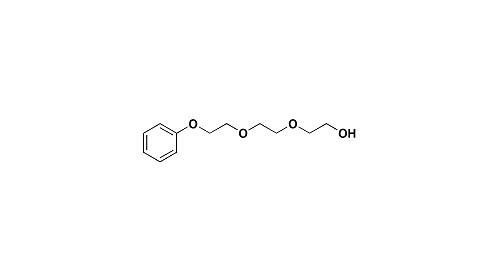
Triethylene glycol monophenyl ether (CAS No.: 7204-16-2) has the molecular formula C₁₂H₁₈O₄ and a molecular weight of 226.27. Its structure consists of a triethylene glycol chain (—(OCH₂CH₂)₃—) linked to a benzene ring via an ether bond (—O—), forming a linear non-ionic surfactant. This structure provides a good balance of hydrophilicity and lipophilicity, along with low volatility and chemical stability.
**2. Production Process**
Industrially, it is produced by condensation of phenol with triethylene glycol in the presence of a basic catalyst (e.g., potassium hydroxide). The reaction temperature is controlled (approximately 120-150°C) to avoid by-product formation. It is then purified by vacuum distillation, achieving a purity of over 99%. Some processes incorporate p-toluenesulfonate intermediates (CAS No.: 730960-08-4) to optimize yield.
**3. Application Scenarios**
As a high-performance solvent, it is widely used in coatings, inks, and resin synthesis as a replacement for traditional high-toxicity solvents (e.g., ethylene glycol ethers). Its low surface tension makes it a key component in metal cleaning agents and textile printing auxiliaries. It is also used in cosmetics as a humectant or emulsifier. In the pharmaceutical field, its derivatives serve as carriers in drug delivery systems, enhancing the bioavailability of poorly soluble drugs.