产品展厅
产品展厅
产品展厅
产品展厅
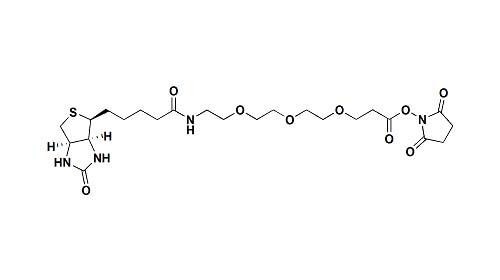
Biotin-PEG3-NHS ester is a biotinylation reagent based on polyethylene glycol (PEG3), consisting of three structural components: Biotin provides high-affinity binding to streptavidin; the PEG3 chain enhances molecular solubility and reduces non-specific adsorption; and the terminal NHS ester reacts specifically with molecules containing primary amines (-NH₂) such as proteins, peptides, or nanomaterials to form stable amide bonds.
The production process typically involves two coupling steps: first, activating the carboxyl group of biotin with NHS to generate Biotin-NHS, which then reacts with amino-functionalized PEG3 in a buffer solution. The target product is obtained after purification.
This reagent is widely used in protein labeling, affinity chromatography purification, cell imaging, and PROTAC molecule development, serving as a key tool for achieving targeted conjugation and functionalization in biomedical research.